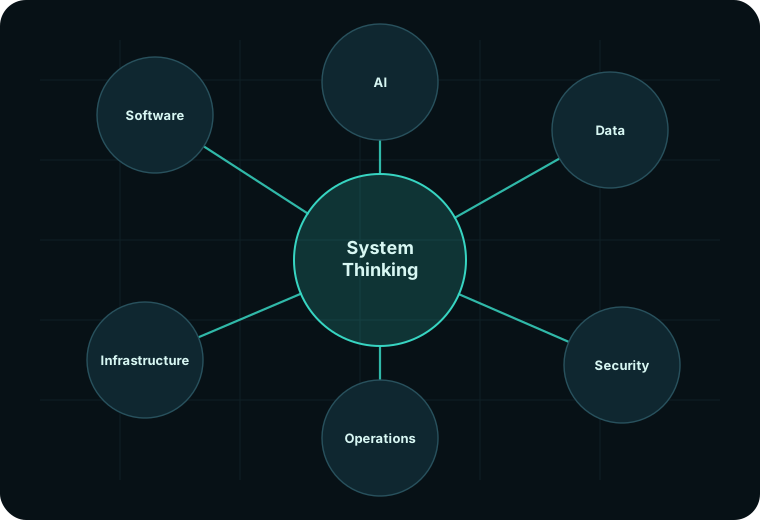
You start as a specialist of one tool. You know one language, one database, one virtualization platform, one operating system inside out. The value is vertical: when the problem falls inside that perimeter, you are the right person.
Then something shifts. Problems stop staying inside one perimeter. A software system needs an infrastructure, the infrastructure needs a network, the network needs security policies, the policies need processes, the processes need evidence, the evidence needs compliance. The specialist of a single layer doesn't see where the problem has moved, because it has already moved elsewhere.
That is where system thinking begins. Not as abstract methodology — as an operational response to the fact that real systems do not respect the disciplinary boundaries on which specialists are organized.
In my path the shift was gradual and for many years invisible to me. Software development, then critical infrastructure, then security, then DevOps, then Kubernetes, then distributed systems, then supercomputing, then local inference, then deterministic verification of AI-generated software. Seen as a list, they look like seven different specialties. Seen as a trajectory, they are one single discipline viewed from different angles: how to hold together technical parts that, taken one at a time, work, but when placed in a real system risk not working together.
The system thinker is not someone who knows everything. They are someone who sees where things meet. Where an architectural assumption made by the developer conflicts with an infrastructure constraint. Where a security choice makes a delivery workflow impossible. Where a local inference pipeline imposes thermal constraints the datacenter operator had never considered. Where the output of an LLM produces plausible code that does not survive the verification pipeline.
This does not replace vertical specialists. On the contrary, it desperately needs them: without the vertical depth of someone who really knows how that thing works, the system thinker has no material to reason on. But amid the verticals you need someone who sees the empty spaces between them — because that is where real projects break.
AI, in this, is the lever that finally made system thinking sustainable at scale. Before, a single professional could hold together two, maybe three complex domains. Beyond that threshold, cognition gave way. Today, with the right orchestration — analysis pipelines, knowledge bases, retrieval, deterministic verification, constrained execution agents — a system thinker can keep many more layers coherent at the same time. The speed of work changes not by a little: it changes by an order of magnitude.
The thread of the career, in retrospect, is clear. It was not about becoming the deepest specialist of one tool. It was about becoming the person who chooses the tool, combines it, verifies it, and places it inside a larger system that actually works. From tool specialist to system thinker. And now, with AI as the amplifier, from system thinker to director of complex systems at scale.