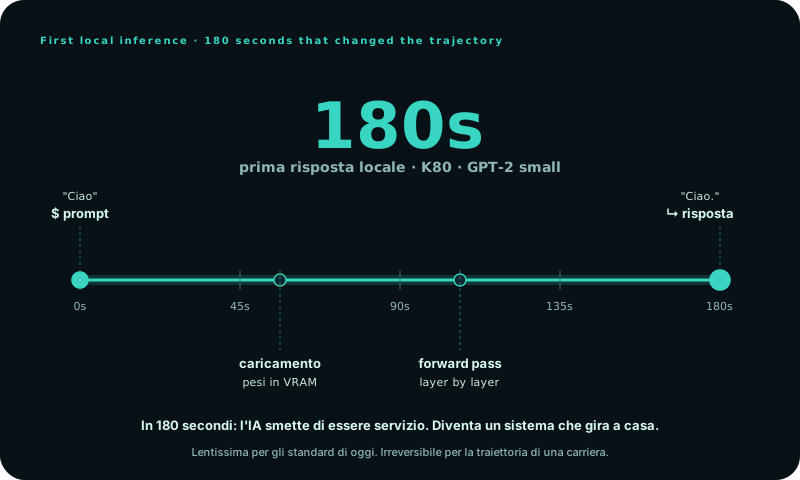
That was the beginning of a project I did not plan.
I came from a software background. I understood Linux, networking, orchestration. I did not understand thermal dynamics, mechanical stress, or material behavior under sustained load. I learned all of it — not from documentation, but from failure.
What followed was three years of iterative design across five complete hardware revisions. Each one taught something the previous could not.
I tested mining rigs first. They look like the same workload — multiple GPUs, high utilization, continuous operation. They are not. Mining tolerates interruption. Inference does not. That distinction alone invalidated an entire class of hardware.
So I started designing from scratch. CAD. Custom aluminum structure. 3D printed components. Every cable, every screw, every mounting angle driven by thermal and mechanical constraints. A cable routed 3 cm off can change a GPU's temperature by several degrees. A wrong fastener can transmit enough vibration to crack silicon in 6-12 months.
I bought motherboards that met every spec on the datasheet and were unusable under real load. I learned that specification compliance and operational viability are not the same thing. That lesson cost money.
I documented everything: why mining configurations fail under inference load. Driver constraints (CUDA 11.x, Kepler end-of-life, GPU enumeration limits). Validation results: 8 GPUs at 100% for 12 continuous hours. Temperature range 35–52°C across all GPUs, with zero thermal drift. For reference, a K80 in a standard server runs 75–90°C under the same load. No datacenter. No liquid cooling. Residential environment, summer conditions.
This is not a guide. It is a set of engineering notes from someone who built, broke, and rebuilt a system five times to make it work.